Fasting on Wegovy during Ramadan: A practical guide for Kuwait
If you are taking Wegovy and planning to fast for Ramadan, the short answer is yes, you can do it safely. But you need a specific strategy.
Fasting on semaglutide (Wegovy) changes how your body handles food and water. The medication already powerfully suppresses your appetite and slows down your digestion. When you combine that with a fasting window of 14 to 15 hours, getting enough protein and fluids between Maghrib and Fajr becomes a real challenge.
Many patients in Kuwait ask their pharmacists about Wegovy Ramadan (ويجوفي رمضان) safety or how to manage fasting with Wegovy (ويجوفي مع الصيام). The main risks are not necessarily blood sugar drops, but rather severe dehydration, worsening nausea, and rapid muscle loss.
Here is exactly how to manage your medication, your meals, and your side effects during the holy month.
Timing your Wegovy injection during Ramadan
The most common question is when to actually take your weekly shot.
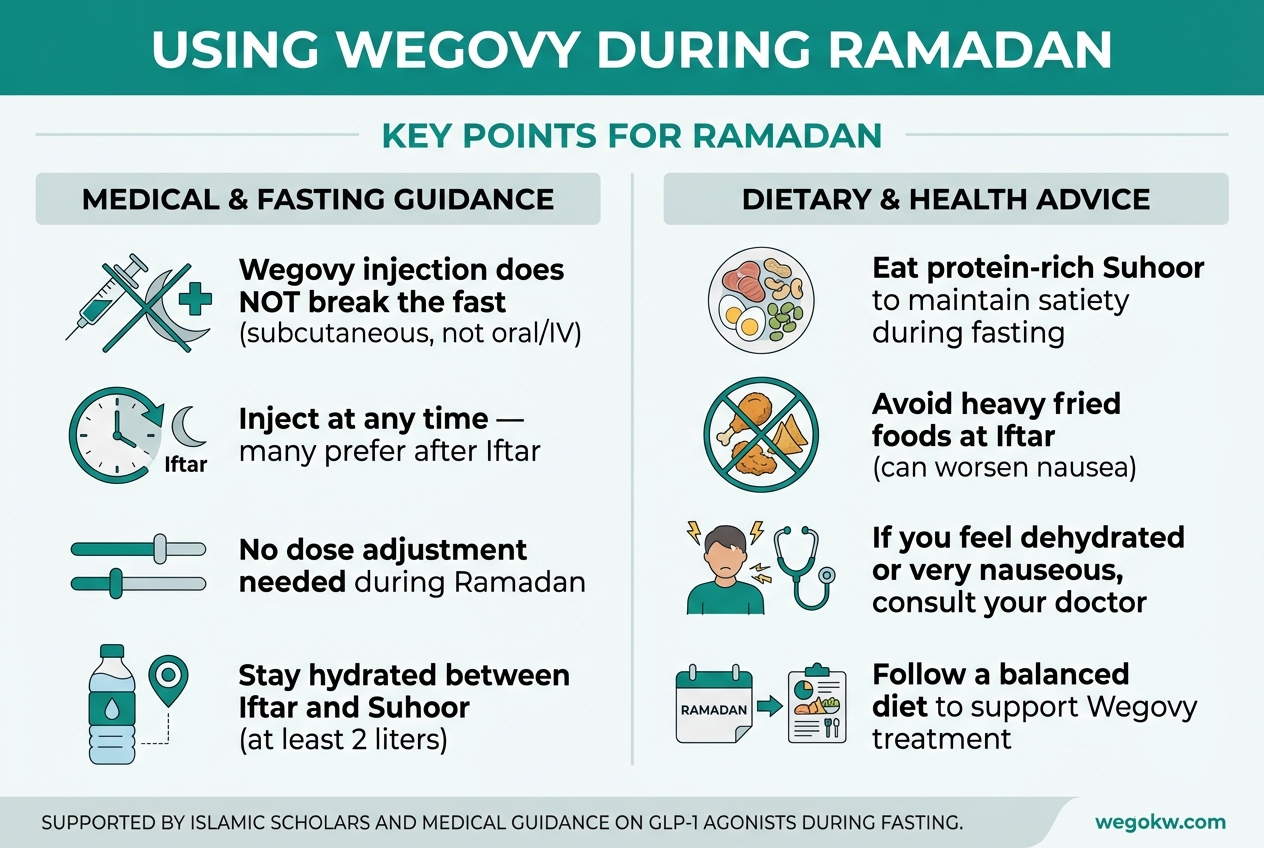
Medical consensus suggests taking your Wegovy injection either right after Iftar or after Suhoor [numan_ramadan_guidance]. Taking it on a completely empty stomach in the middle of the day can make nausea worse. If you take it after a meal, you have a buffer.
There is one major rule for Ramadan: do not increase your dose.
Wegovy follows a strict dosage schedule where you step up to a higher dose every four weeks. Side effects like nausea and vomiting almost always peak during these dose increases. If your scheduled dose increase falls during Ramadan, most doctors recommend staying on your current, tolerated dose until the month is over [ramadan_glp1_advice]. Layering a dose increase on top of a sudden change in your eating and sleeping habits is a recipe for severe stomach issues.
The Iftar strategy: Avoiding the "double-slowing" effect
Wegovy works partly by delaying gastric emptying. It keeps food in your stomach longer so you feel full.
Think of your stomach as a slow-moving conveyor belt. If you break your fast with heavy, fried, or high-fat foods—like samosas, fried kibbeh, or rich cream sauces—you create a "double-slowing" effect. These foods naturally take a long time to digest. When you add Wegovy to the mix, that heavy meal sits in your stomach for hours, leading to severe bloating, acid reflux, and prolonged nausea [gi_side_effects_review_2025].
Instead, break your fast gently. Start with water and a couple of dates, then move to a broth-based soup. Soup is excellent because it provides high water content, is easy to digest, and helps prevent dehydration.
Wait 15 to 20 minutes before eating your main meal. This gives your slowed digestive system time to wake up.
Protein first, no exceptions
When you sit down for your main Iftar meal, eat your protein before anything else on your plate.
This is the single most important dietary rule on Wegovy. Because the medication cuts your appetite by up to 39% naturally [blundell_energy_intake_2017], you will likely get full very quickly. If your first few bites are rice, bread, or noodles, you will be too full to eat your meat, chicken, or fish.
Why does this matter so much? Muscle loss.
In the major STEP 1 clinical trial, people lost an average of 15% of their body weight over 68 weeks. But up to 45% of the weight they lost was lean muscle mass, not fat [step1_dxa_substudy]. Losing that much muscle slows down your metabolism and leaves you feeling weak.
To protect your muscle, clinical guidelines recommend eating 1.2 to 1.6 grams of protein per kilogram of your body weight every day while on GLP-1 medications [joint_advisory_aclm_2025]. For an 85 kg person, that means aiming for about 100 to 136 grams of protein daily.
Hitting that target during Ramadan is tough. You have to be deliberate. Focus on nutrient-dense proteins that give you the most grams per bite: * Grilled chicken breast or white fish * Eggs (excellent for Suhoor) * Greek yogurt or cottage cheese * Protein shakes (a great backup if you feel too full to chew solid food)
Managing nausea on an empty stomach
Gastrointestinal side effects are a normal part of the Wegovy process. About 44 out of 100 people experience nausea at some point during their treatment [step1_clinical_trials].
Fasting can sometimes trigger nausea because your stomach is completely empty for hours. If you feel sick during the day, you obviously cannot eat crackers or drink water to settle your stomach.
To prevent daytime nausea, pay close attention to your Suhoor. Avoid spicy foods, which irritate the stomach lining and worsen acid reflux. Skip highly processed sugary foods, which cause your blood sugar to spike and then crash, making nausea worse.
During your eating window, ginger is highly effective. A 2023 clinical trial showed that ginger significantly improves nausea for patients with slowed digestion [ginger_rct_2023]. Drinking ginger tea or peppermint tea between Iftar and Suhoor can help calm your stomach muscles and keep digestion moving.
You should also adopt a "small, frequent meals" approach. Instead of a massive Iftar and a heavy Suhoor, break your food up. Have a light Iftar, a small protein-heavy snack during evening Ghabga gatherings, and a balanced Suhoor. Smaller portions prevent your stomach from stretching too much at once.
Hydration: Drink between meals, not during
Dehydration is a serious risk when fasting in Kuwait, especially as temperatures rise. Wegovy makes this trickier because you simply don't feel as thirsty, and drinking a lot of water at once can make you feel uncomfortably full.
You need at least 2 liters (about 64 ounces) of water daily.
The best way to get this without triggering nausea is to drink between your meals, not during them. If you drink two glasses of water right before or during Iftar, you will fill whatever small space is left in your stomach, leaving no room for protein.
Sip water constantly from the time you break your fast until you sleep. Keep a water bottle with you during Taraweeh prayers.
Protecting your muscle mass while fasting
We already talked about eating enough protein to stop muscle loss. The second half of that equation is exercise.
You might feel tired while fasting, but stopping all physical activity for a month will accelerate muscle loss. A landmark medical trial showed that combining exercise with weight-loss injections doubled the reduction in body fat percentage compared to taking the medication alone, while actively protecting lean muscle [lundgren_nejm_2021].
You do not need to do intense, exhausting workouts while fasting. The goal is muscle preservation.
Try to fit in two days of light resistance training per week. Using resistance bands, light dumbbells, or even just your own body weight (like squats and modified push-ups) signals to your body that it needs to keep its muscle tissue.
Timing your workout is a personal choice. Some people prefer lifting weights an hour before Iftar so they can immediately rehydrate and eat protein. Others prefer working out a few hours after Iftar when their energy levels are higher. Listen to your body. If you feel dizzy or lightheaded, stop.
For cardio, a brisk 30-minute walk indoors (to avoid Kuwait's heat) is plenty. The American College of Sports Medicine recommends 150 minutes of moderate activity per week [acsm_guidelines_2024], which you can break into small 20-minute sessions after dinner.
Common Questions
Can I start Wegovy for the first time during Ramadan? Doctors generally advise against starting Wegovy during Ramadan. The first few weeks of treatment are when your body is adjusting to the medication, and side effects like nausea, diarrhea, or vomiting are most common. Dealing with these side effects while fasting and adjusting to a new sleep schedule can be overwhelming and increases your risk of dehydration.
What if I vomit during fasting hours? If Wegovy causes you to vomit during the day, you are losing fluids that you cannot replace until sunset. If you vomit repeatedly, medical guidelines advise breaking your fast to drink water and rehydrate. Severe dehydration can lead to kidney issues, which is a known, though rare, risk with semaglutide.
Should I skip a dose if I feel too sick to fast? If you are experiencing severe side effects that make fasting impossible or unsafe, speak to your doctor. They may recommend delaying your dose by a few days until your stomach settles. Do not stop the medication completely without medical advice, as you may have to restart the dose escalation from the beginning if you miss too many weeks.
Does Wegovy make fasting easier? For many people, yes. Because Wegovy significantly reduces appetite and delays stomach emptying, many patients report feeling much less hungry during the long fasting hours compared to previous years. However, you still need to actively manage your nutrition during the eating window to stay healthy.
Related Pages * Wegovy dosage schedule: What to expect month by month * Diet tips for Wegovy: What to eat and what to avoid
*
This article is based on the Kuwait HA-approved Wegovy leaflet (revised September 2024) and published clinical evidence. It does not replace advice from your doctor.