Wegovy vs Ozempic: The Same Molecule on Different Missions
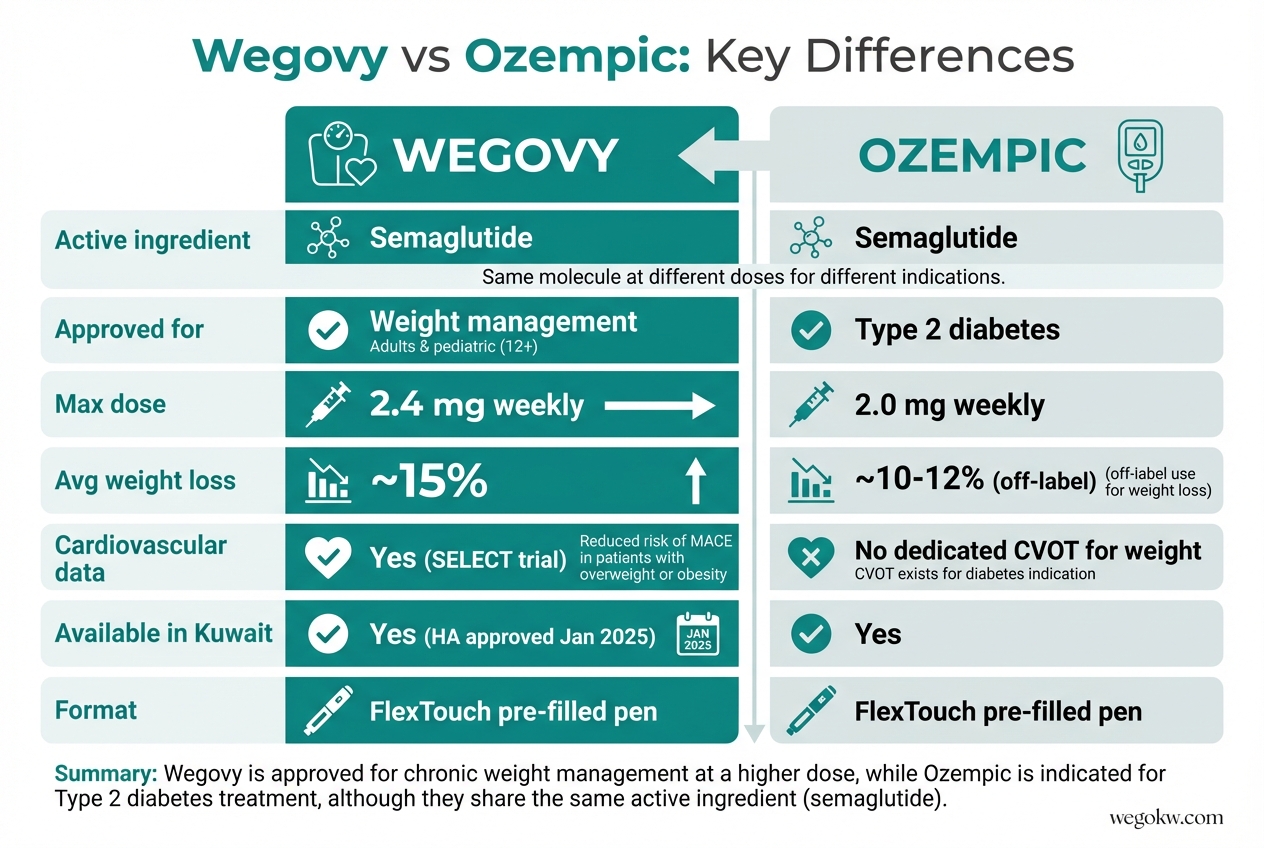
Wegovy and Ozempic are the exact same drug inside the pen.
If you look at the active ingredient on either box at your local pharmacy, you will see the same word: semaglutide. Both medications are manufactured by the same Danish company, Novo Nordisk. Both work by mimicking a hormone in your body that slows down your stomach and tells your brain you are full.
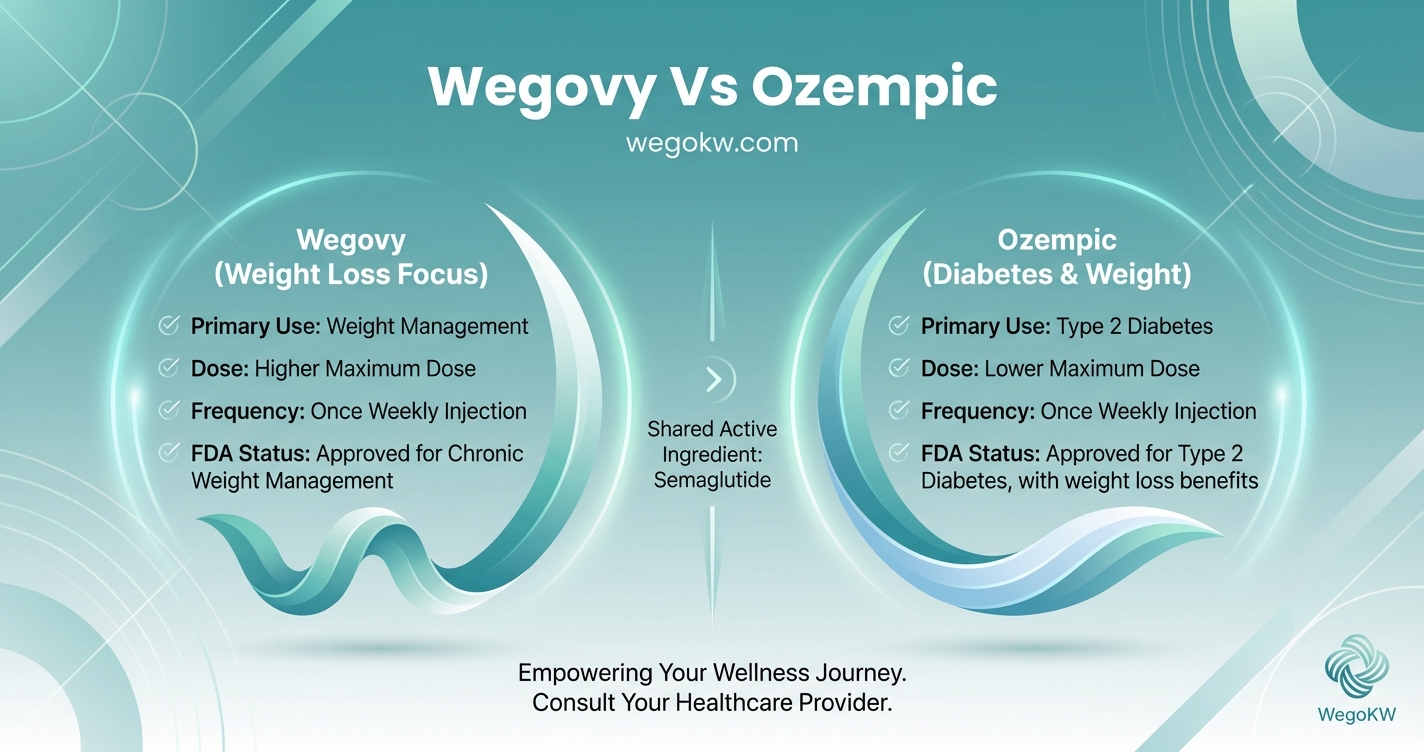
Yet, these two medications serve fundamentally different purposes. They carry different official approvals, come in different doses, use entirely different injection pens, and exist in very different insurance landscapes here in Kuwait.
The short answer is that Ozempic is strictly for type 2 diabetes, while Wegovy is specifically for weight loss. But the reality of how these drugs are prescribed and used is much more complicated.
Here is exactly how Wegovy and Ozempic compare, what the clinical trials show, and what you need to know if you are considering either medication.
One active ingredient, two different approvals
Semaglutide belongs to a class of medications called GLP-1 receptor agonists. When Novo Nordisk developed this molecule, they realized it did two things exceptionally well: it lowered blood sugar, and it caused significant weight loss.
Because treating diabetes and treating obesity require different clinical trials and dosing schedules, the company split the molecule into two distinct brands.
Ozempic came first. The FDA approved it in late 2017 exclusively for adults with type 2 diabetes [fda_ozempic_2017]. Its primary job is to improve blood sugar control. Over time, its approved uses expanded to include lowering the risk of major cardiovascular events (like heart attacks and strokes) in diabetic patients with heart disease. Recently, it was also approved to help protect kidney function in diabetic patients. Ozempic does not have an official approval for weight loss.
Wegovy arrived a few years later, in the summer of 2021 [fda_wegovy_2021]. It was approved specifically for chronic weight management in adults with a body mass index (BMI) of 30 or higher. You can also qualify with a BMI of 27 or higher if you have a weight-related health condition like high blood pressure or high cholesterol. Wegovy's label has since expanded to include teenagers aged 12 and older, reducing cardiovascular risk in overweight adults, and treating certain types of liver disease.
Dosing and pens: How you actually take them
Even though the liquid inside is the same, the way you inject these medications is completely different. This is often the biggest surprise for patients switching from one to the other.
Wegovy uses single-use, prefilled pens. Each pen contains exactly one dose. You press the pen flat against your skin, it clicks, the medicine goes in, and you throw the entire pen away. You cannot adjust the dose. To help your body get used to the medication and minimize nausea, Wegovy follows a strict 16-week step-up schedule. You start at 0.25 mg for a month, then move to 0.5 mg, 1.0 mg, 1.7 mg, and finally reach the maintenance dose of 2.4 mg.
Ozempic uses a multi-dose pen. One pen lasts for several weeks. You attach a fresh needle each time, turn a dial on the end of the pen to select your dose, and inject. This allows doctors to be much more flexible. A doctor might keep a patient on a low dose of Ozempic for months if their blood sugar is well-controlled. Ozempic's maximum approved dose is 2.0 mg — slightly lower than Wegovy's top dose.
Because Wegovy pushes the dose higher than Ozempic, researchers have also studied higher-dose semaglutide programs for people who need more weight loss than the current 2.4 mg pen can provide. Exact rollout timing and Kuwait availability can differ from global announcements.
Weight loss results: What the numbers actually say
Since both drugs contain semaglutide, both cause weight loss. But because Wegovy goes up to a higher dose, the weight loss results are generally stronger.
We know exactly how they compare because researchers tested them in massive global studies called the STEP and SUSTAIN trials.
When researchers tested the highest dose of Wegovy (2.4 mg) in people who were overweight but did not have diabetes, the results were striking. In the STEP 1 trial, people lost an average of 14.9% of their body weight over 68 weeks [step1_nejm]. Half of the people in the study lost at least 15% of their starting weight.
But what happens when you compare the Wegovy dose directly against the standard Ozempic dose?
The STEP 2 trial did exactly that, focusing on people who had both obesity and type 2 diabetes [step2_lancet]. Here is what they found over 68 weeks: * People taking the 2.4 mg Wegovy dose lost an average of 9.6% of their body weight. * People taking the 1.0 mg Ozempic dose lost an average of 7.0%. * People taking a placebo lost 3.4%.
You might notice that the weight loss in STEP 2 (9.6%) was lower than in STEP 1 (14.9%). This highlights a well-known medical reality: people with type 2 diabetes consistently lose less weight on GLP-1 medications than people without diabetes. Their metabolisms respond differently to the drug.
The extra medication in Wegovy primarily buys you extra weight loss. When researchers looked at blood sugar control in that same trial, the 2.4 mg dose and the 1.0 mg dose lowered HbA1c by almost the exact same amount.
The off-label debate and the Ozempic shortage
If Wegovy is the official weight-loss drug, why is Ozempic so famous for weight loss?
The answer comes down to timing, supply, and insurance.
When Wegovy launched, demand was so high that Novo Nordisk simply could not manufacture enough single-use pens. Patients who wanted to lose weight, and doctors who wanted to help them, realized that Ozempic was the exact same molecule. So, doctors began prescribing Ozempic "off-label" for weight loss.
Off-label prescribing is perfectly legal. It means a doctor is prescribing an approved drug for an unapproved use because they believe it will help the patient.
The scale of this shift was massive. Recent healthcare data shows that about one-third of all people taking Ozempic do not actually have a diabetes diagnosis [trilliant_health_data]. Between 2018 and 2022, off-label prescriptions for semaglutide jumped by 256%.
This massive surge in off-label use triggered a global Ozempic shortage that lasted nearly three years. People with type 2 diabetes suddenly found themselves unable to get the medication they relied on to control their blood sugar.
Medical organizations, including the Endocrine Society, strongly advise against prescribing diabetes medications solely for weight loss when they aren't approved for it [endocrine_society_guidelines]. Novo Nordisk has repeatedly stated they do not support off-label use. Yet, the practice continues, largely driven by economics. Health insurance plans frequently cover Ozempic for diabetes but flatly refuse to cover Wegovy for weight loss. For many patients, getting an off-label Ozempic prescription is the only way they can afford the medication.
Managing side effects
Because they are the same drug, Wegovy and Ozempic share the exact same side effect profile. The most common issues are related to your stomach and digestion.
When you first start taking semaglutide, or when you move up to a higher dose, you are likely to feel it. About 44 out of 100 people experience nausea on the higher doses of Wegovy. Other common side effects include diarrhea, vomiting, constipation, and stomach pain.
These side effects are usually temporary. They tend to peak in the days immediately following your injection and gradually fade as your body gets used to the medication. This is exactly why both drugs start at a tiny 0.25 mg dose and slowly build up over several months.
Living in Kuwait: Practical tips for both medications
Taking a GLP-1 medication in Kuwait comes with a few unique local considerations, regardless of whether you are using the Wegovy or Ozempic pen.
Handling the summer heat Semaglutide is a fragile protein. Unused pens must be kept in the refrigerator (between 2°C and 8°C). Once you start using a pen, it can be kept at room temperature for up to 28 days for Wegovy, or 56 days for Ozempic — but "room temperature" strictly means under 30°C.
During a Kuwait summer, 30°C is a distant memory. Never leave your medication in your car while running errands, and do not leave it sitting in direct sunlight by a window. If the liquid inside the pen looks cloudy or has particles floating in it, the heat has destroyed the medication and you must throw it away.
Fasting during Ramadan If you plan to fast during Ramadan while taking Wegovy or Ozempic, you need to plan ahead with your doctor. Because these medications slow down how fast your stomach empties, you will feel full much faster during Iftar.
Overeating when you break your fast is a guaranteed recipe for severe nausea and vomiting. You will need to eat much smaller portions than you are used to. Hydration is also a major concern. The medication can blunt your thirst mechanism, making it easy to become dehydrated during the long fasting hours. You have to consciously sip water throughout the non-fasting hours.
Cost and insurance in Kuwait In local pharmacies, the pricing and insurance coverage for these two drugs look very different. If you have type 2 diabetes, many private health insurance plans in Kuwait will cover Ozempic.
Wegovy is a different story. Most insurance providers in the region classify weight-loss medications as "lifestyle" or "cosmetic" treatments and exclude them from standard coverage. This means you will likely be paying out of pocket in KWD for Wegovy. Because Wegovy requires four single-use pens per month, the monthly cost is often higher than a single multi-dose Ozempic pen. Always check with your specific insurance provider, as policies are slowly beginning to change for patients with high BMIs and related health risks.
Common Questions
Can I switch from Ozempic to Wegovy? Yes. Because they are the exact same active ingredient, doctors frequently switch patients between the two. If you are already taking 1.0 mg of Ozempic, your doctor will usually start you on the 1.0 mg or 1.7 mg dose of Wegovy so you don't have to start over from the beginning.
Is Wegovy stronger than Ozempic? The medication itself is not stronger, but the maximum dose is higher. Wegovy goes up to 2.4 mg per week, while Ozempic stops at 2.0 mg per week. That extra medication is why Wegovy generally produces slightly more weight loss.
Why did my doctor prescribe Ozempic if I don't have diabetes? Your doctor likely prescribed it "off-label" for weight loss. This happens frequently when Wegovy is out of stock at local pharmacies, or when a patient's insurance will only cover the diabetes brand.
Do I have to stay on these medications forever? Current medical guidelines view obesity as a chronic condition, much like high blood pressure. Clinical trials show that if you stop taking semaglutide, your appetite will return, and you are likely to regain a significant portion of the weight you lost within a year. Most doctors recommend planning for long-term maintenance.
Related Pages * Wegovy vs Mounjaro: Which is right for you? * Can you take Wegovy if you have diabetes?
*
This article is based on the Kuwait HA-approved Wegovy leaflet (revised September 2024) and published clinical evidence. It does not replace advice from your doctor.