Wegovy Side Effects: What to Expect and How to Manage Them
About 73 out of 100 people taking Wegovy will experience some kind of stomach upset during their treatment [step_trials_gi]. If you are starting this medication, you are probably wondering exactly what those side effects are, how bad they get, and how long they last.
The short answer is that most side effects are mild to moderate, and they usually peak during your first few months. Because Wegovy (semaglutide) fundamentally changes how your body digests food, your daily habits have to change with it. What you eat, how much you drink, and even the order in which you eat the food on your plate will dictate how you feel.
Whether you are searching for "wegovy side effects" in English or looking up "أعراض ويجوفي الجانبية" (Wegovy side effects) in Arabic, the advice remains the same. Here is exactly what the clinical data shows, and how you can manage your symptoms practically while living in Kuwait.
The "Big Four" Stomach Side Effects
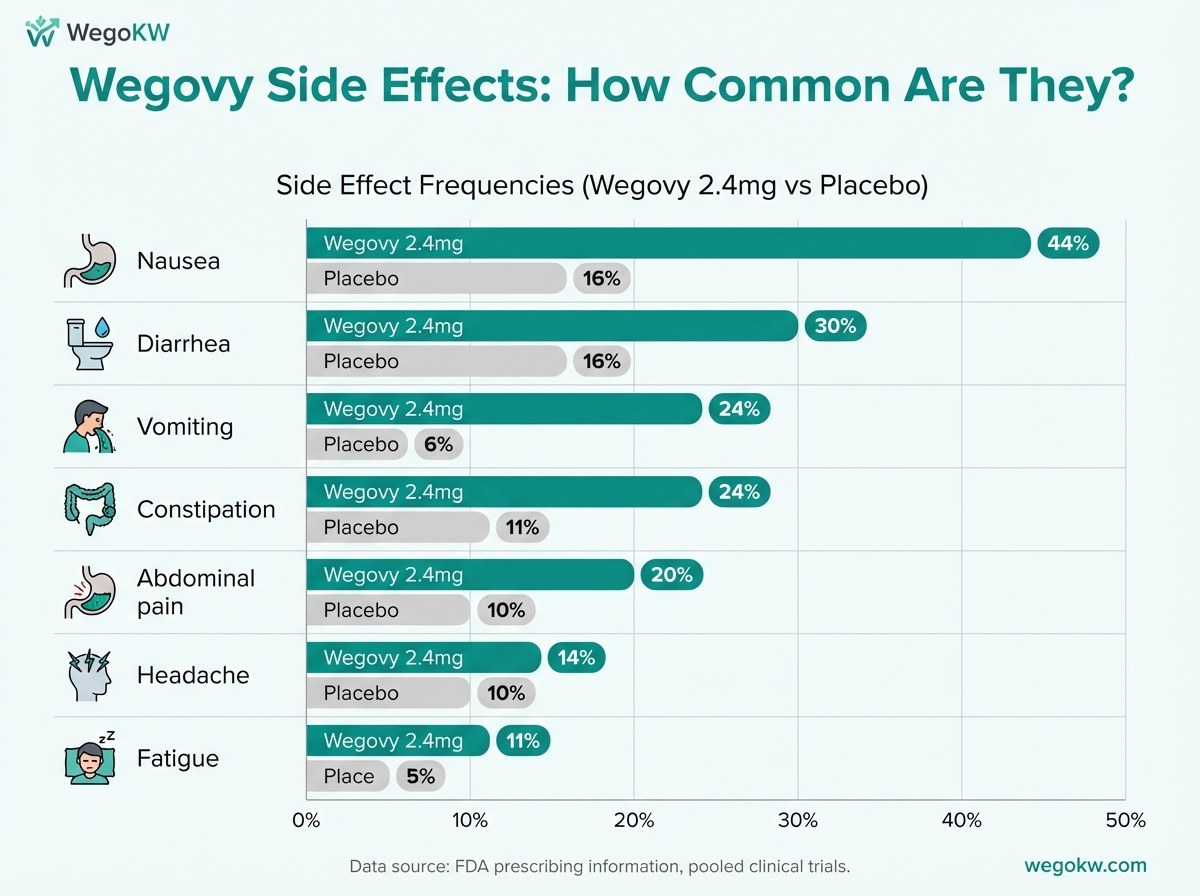
Gastrointestinal (GI) issues are the most common hurdle. In the major clinical trials for Wegovy, nearly three-quarters of patients reported at least one stomach-related issue [step_trials_gi].
Here is what people actually experience: * Nausea: Affects about 44 out of 100 people. * Diarrhea: Affects roughly 30 out of 100 people. * Vomiting: Affects about 25 out of 100 people. * Constipation: Affects about 24 out of 100 people, often lasting for several weeks.
Why does this happen? Wegovy works partly by delaying gastric emptying. It slows down the rate at which food leaves your stomach. This is great for keeping you full, but it means food sits in your digestive tract much longer than you are used to.
These symptoms almost always peak during your dose escalation phase—the first few months when you are slowly increasing your medication. By the time you reach week 20 and settle into your maintenance dose, your body usually adapts and the side effects level off. You can read more about how this timeline works in our Wegovy dosage schedule guide.
How to Manage Nausea and Stomach Upset
Since your stomach is emptying slowly, anything that naturally takes a long time to digest will cause a "double-slowing" effect. This is a guaranteed recipe for nausea and bloating.
Fried foods, heavy cream sauces, and high-fat meals sit in your stomach for hours. If you eat a heavy Kuwaiti machboos with fatty meat, you will likely feel uncomfortably full—and possibly sick—long after the meal is over. High-sugar foods are just as tricky. They spike your blood sugar and then crash it, which makes nausea worse. Carbonated drinks add gas to a stomach that is already full and slow to empty.
When nausea hits, you need foods that are gentle on a compromised digestive system. Here is what actually helps:
- Bland, low-fat proteins: Scrambled eggs, grilled chicken breast, white fish, and Greek yogurt.
- The BRAT approach: Bananas, plain rice, applesauce, and toast are easy to digest when you feel acutely sick.
- Ginger: This is not just an old wives' tale. A recent clinical study showed that taking ginger capsules (about 84 mg of active gingerols per day) significantly improved nausea for patients [ginger_nausea_trial]. Ginger naturally increases stomach contractions, which directly counteracts Wegovy's slowing effect.
- Small, frequent meals: Instead of eating three large meals, break your food up into four or five mini-meals. A smaller volume of food is much easier for your slowed stomach to process.
The Hidden Side Effect: Muscle Loss
When people talk about "أعراض ويجوفي" (Wegovy symptoms), they usually mean nausea. But the most significant side effect happens quietly: losing muscle instead of fat.
In the STEP 1 clinical trial, participants lost an impressive average of 15% of their body weight over 68 weeks. However, detailed body scans revealed that up to 40–45% of that lost weight was lean muscle mass [step1_dxa]. Losing that much muscle weakens your metabolism and leaves you feeling exhausted.
To prevent this, you have to change how you build your meals. The single most important rule on Wegovy is to eat your protein first, every single time.
Because the medication suppresses your appetite so powerfully, you will rarely finish your meals. If your first few bites are bread, rice, or salad, you will get full before you touch your chicken or fish. Your protein intake will plummet.
Medical guidelines recommend getting 1.2 to 1.6 grams of protein per kilogram of body weight every day while on this medication, with an absolute minimum of 60 grams daily [joint_advisory_2025].
In practice, if you weigh 85 kg, you should aim for roughly 102 to 136 grams of protein daily. When your appetite is low, focus on nutrient-dense proteins like eggs, cottage cheese, and fish. If you cannot stomach solid food because of nausea, a protein shake is a perfectly fine backup.
Why Eating Too Little Makes You Feel Worse
Many people assume that to lose weight faster, they should combine Wegovy with a strict, very-low-calorie diet. This almost always backfires.
Wegovy naturally reduces how much you want to eat by 24% to 39% without you even trying [semaglutide_intake_study]. That equals about 700 fewer calories a day. If you try to force an extreme diet on top of that, you create a dangerous compounding effect.
Extreme calorie restriction makes side effects worse. It accelerates muscle loss. It also causes your resting metabolism to drop by roughly 17% after just eight weeks [metabolic_adaptation]. Your body thinks it is starving, so it holds onto fat and burns muscle instead.
The sweet spot is a moderate 500-calorie deficit. Let the medication do the heavy lifting of reducing your appetite—often called silencing Wegovy food noise—and focus your energy on eating high-quality food, not just eating less.
Hydration: The "Between Meals" Rule
Staying hydrated on Wegovy is harder than it sounds. You need at least 2 liters (about 64 ounces) of water a day. In the Kuwait summer heat, falling behind on your water intake can quickly lead to severe constipation and dizziness.
But when you drink matters just as much as how much you drink.
Because your stomach empties slowly, drinking a large glass of water right before or during a meal will fill you up instantly. You will feel bloated, you won't be able to eat your protein, and you might feel nauseous.
The best strategy is to drink your water between meals. Stop drinking about 30 minutes before you eat, and wait 30 minutes after you finish eating before you start drinking again. This gives your stomach room to process the solid food.
Managing Side Effects During Ramadan
Fasting during Ramadan requires a specific strategy when you are on Wegovy. Because your stomach empties slowly, eating a massive Iftar meal will almost certainly cause severe bloating and acid reflux.
Break your fast gently. Start with water, a date, and a small portion of easily digestible protein, like a few spoons of Greek yogurt or a piece of grilled chicken. Wait an hour or two before eating a slightly larger meal.
Hydration is your biggest challenge during the non-fasting hours. You cannot chug a liter of water at Suhoor because your stomach won't empty fast enough to handle it. You have to sip water continuously throughout the night from Iftar to Suhoor to hit your 2-liter goal without making yourself sick.
Common Questions
How long do Wegovy side effects usually last? For most people, stomach issues peak during the first few months while you are increasing your dose. By the time you reach your target maintenance dose (usually around week 20), your body adapts and the nausea and bloating typically fade.
Should I skip my dose if I feel really sick? If you are experiencing severe vomiting or cannot keep water down, contact your doctor. You may need to delay your dose or step back down to a lower dose. You can find more details on how to handle this in our Wegovy missed dose guide.
Why am I so constipated on Wegovy? The medication slows down your entire digestive tract. Food takes longer to pass through, which means your body absorbs more water from it, leaving your stool hard. Drinking 2 liters of water daily and eating enough fiber are the best ways to keep things moving.
Does Wegovy affect your heart rate? Yes, you might notice a slight increase in your resting heart rate. This is a known effect of the medication. However, if you feel your heart racing uncomfortably or you feel dizzy and lightheaded, you should speak with a healthcare provider.
Related Pages * Wegovy Dosage Schedule: Step-by-Step Guide * What to Do If You Miss a Wegovy Dose * How Wegovy Stops Food Noise
*
See our full list of medical references for the studies cited in this article.
This article is based on the Kuwait HA-approved Wegovy leaflet (revised September 2024) and published clinical evidence. It does not replace advice from your doctor.