Wegovy vs. Bariatric Surgery: Which is Right for You?
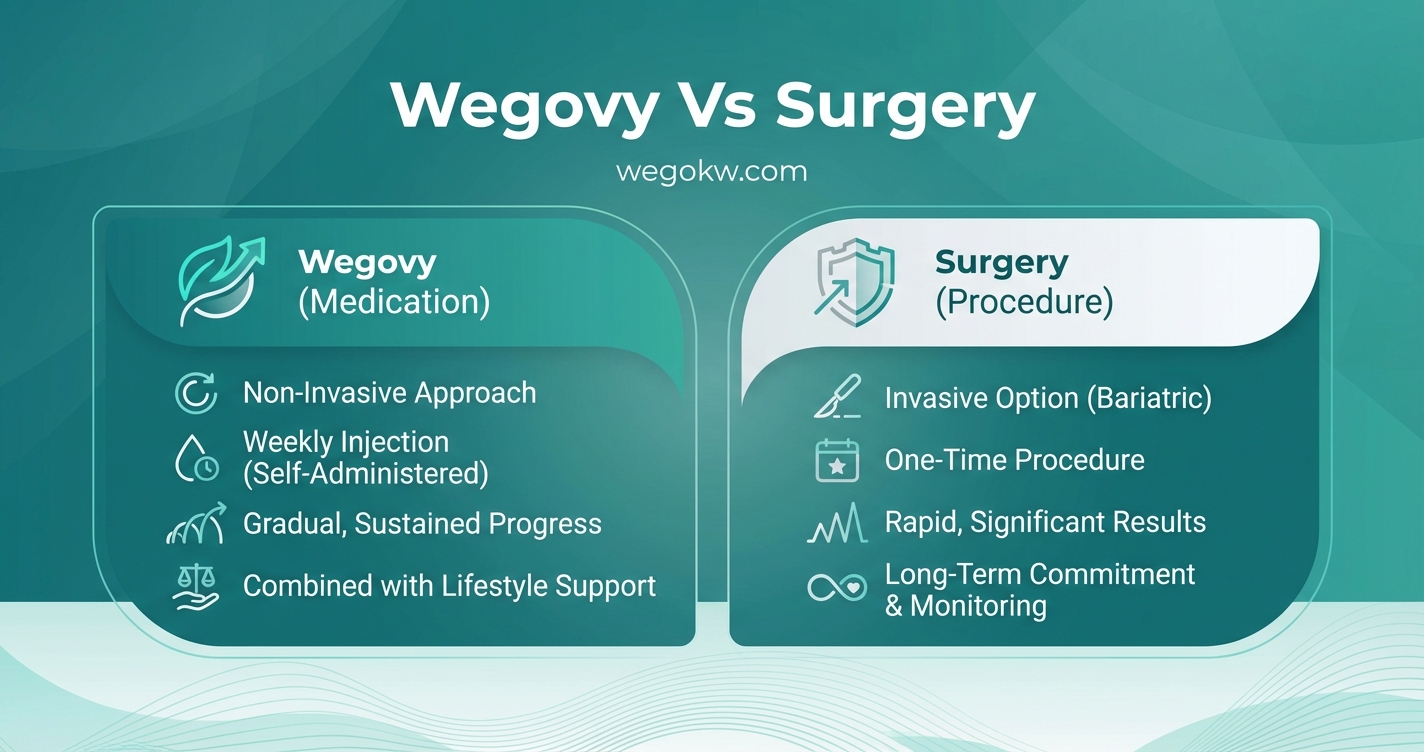
Bariatric surgery delivers roughly double the weight loss of Wegovy and costs less over a lifetime. The catch? It demands a permanent change to your anatomy. Wegovy offers a reversible, no-surgery alternative, but you have to take weekly injections indefinitely to keep the weight off.
In Kuwait, this comparison comes up daily. With adult obesity sitting above 37%, Kuwait performs more weight-loss surgeries per capita than any other nation on earth [kuwait_obesity_data]. Both options are readily available here today. You can get surgery through public hospitals (which is free for citizens) or private clinics, and Wegovy is stocked in local pharmacies.
Choosing between a scalpel and a syringe comes down to your body mass index (BMI), your budget, and whether you prefer a one-time permanent change or lifelong flexibility. Let's look at what the clinical data actually says.
How much weight will you actually lose?
When you compare the numbers directly, surgery wins on sheer volume of weight lost.
Surgeons often measure success in "excess weight loss"—meaning the extra weight you carry above a healthy BMI. But to compare surgery directly to Wegovy, we have to look at total body weight.
What surgery delivers According to the American Society for Metabolic and Bariatric Surgery (ASMBS), surgery helps people lose about 25% to 35% of their total body weight within the first year [asmbs_2025].
If you weigh 120 kg, a gastric bypass could help you drop 36 to 42 kg. A gastric sleeve usually results in a slightly lower 30 to 36 kg loss. Long-term studies show excellent durability. Most patients keep about 24% to 28% of that total body weight off for a decade or more.
What Wegovy delivers Wegovy is highly effective for a medication, but it doesn't quite match surgery. In the landmark STEP 1 clinical trial, people taking Wegovy lost an average of 14.9% of their body weight over 68 weeks [step1_nejm]. For that same 120 kg person, that means losing about 18 kg.
The STEP 5 trial followed patients for two full years and found they maintained a 15.2% weight loss, proving the medication keeps working as long as you keep taking it [step5_nature].
Here's what matters: in the real world, people often lose less than they do in clinical trials. Recent data shows real-world GLP-1 users losing between 4.7% and 10.3% of their body weight [real_world_glp1]. Why the drop? Because in the real world, people forget doses, experience side effects, or simply stop paying for the medication. Over half of patients stop taking Wegovy within the first year.
The permanence tradeoff: Anatomy vs. Injections
This is the central choice you have to make. Do you want a permanent physical change, or a flexible medical one?
The reality of bariatric surgery Surgery is a one-time event with lifelong rules. The two main procedures work differently:
Gastric sleeve: This is the most popular option globally, making up about 60.4% of all weight-loss surgeries [asmbs_2025]. The surgeon permanently removes 75% to 80% of your stomach, leaving a narrow tube about the size of a banana. It restricts how much you can eat (just 1 to 5 ounces at a time). It also removes the part of the stomach that produces ghrelin, your main hunger hormone. Once that tissue is gone, you cannot get it back.
Gastric bypass: This makes up about 29.5% of surgeries. The surgeon creates a tiny, egg-sized pouch from your upper stomach and connects it directly to your small intestine. It restricts food and reduces how many calories your body absorbs. It is technically reversible, but doctors almost never reverse it because the second surgery is incredibly complex and risky.
(Worth noting: You might have heard of the lap-band. It involves placing an adjustable silicone ring around the stomach. While it is fully reversible, it has mostly fallen out of favor. Today, it accounts for less than 1% of surgeries because up to half of patients eventually need the band removed due to complications or poor results.)
The reality of Wegovy Wegovy involves zero anatomical changes. It is a purely medical treatment.
You inject yourself once a week under the skin of your stomach, thigh, or arm. The active ingredient, semaglutide, mimics a hormone called GLP-1. It tells your brain you are full and slows down how fast your stomach empties.
There is no surgical recovery time. You don't have to take time off work. But the trade-off is that obesity is treated as a chronic condition. Just like taking blood pressure medication, you have to keep taking Wegovy to keep the disease in check.
What happens when you stop?
This is the biggest limitation of Wegovy. When the medication stops, the weight comes back.
In a follow-up to the STEP 1 trial, researchers tracked people after they stopped taking Wegovy. Within one year of stopping the injections, participants regained about two-thirds of the weight they had lost [step1_extension]. Their blood pressure, cholesterol, and blood sugar levels also started creeping back up toward where they started.
Some people hope they can use Wegovy for a year, lose the weight, build good habits, and then stop. The data suggests this is very difficult. The biological drive to regain weight is incredibly powerful. Once the medication leaves your system, your appetite returns in full force. A recent review estimated that only about 24% of your initial weight loss will stick around long-term after you stop the injections [regain_meta_2025].
That said, a large review of patient records by Epic Research showed a slightly more optimistic picture. Looking at over 188,000 patients, they found that two years after stopping semaglutide, about 56% of people maintained at least some of their weight loss [epic_research_2024]. This means if you strictly maintain your new diet and exercise habits, you have a fighting chance—but it will be an uphill battle against your own biology.
Surgery, by contrast, enforces portion control permanently. While some weight regain is normal years after a sleeve or bypass, the physical restriction makes it much harder to regain all the weight.
Cost comparison in Kuwait
The financial math looks very different depending on whether you are a Kuwaiti citizen or an expat, and whether you look at short-term or long-term costs.
Surgery costs: For Kuwaiti citizens, bariatric surgery is available at no cost through government hospitals, though waitlists can be long. In the private sector, a sleeve or bypass typically costs between KWD 2,000 and KWD 5,000 depending on the hospital and surgeon. It is a large upfront expense.
Wegovy costs: Wegovy is an ongoing subscription to weight loss. At Spirit Pharmacy in Kuwait, the maintenance dose (2.4 mg) costs 94.750 KWD per month, which works out to roughly 1,137 KWD per year. Starting doses are cheaper at 39.480 KWD per month. Spirit also offers interest-free installment options through Tabby, Taly, and Deema (4 payments, no interest).
If you pay out of pocket, two to four years of Wegovy will equal the cost of private bariatric surgery. Since Wegovy is meant to be taken indefinitely, it eventually becomes the much more expensive option over a lifetime.
Daily life: Eating, Ramadan, and side effects
How you live day-to-day changes drastically depending on which path you choose.
Life after surgery Surgery requires permanent dietary discipline. You have to eat very small portions. You must separate eating from drinking—no water for 30 minutes before or after meals, otherwise you risk flushing food through your system too quickly or stretching your pouch.
You also have to commit to lifelong vitamin supplements. Because your stomach is smaller (or bypassed entirely), your body cannot absorb nutrients as well. You will need daily bariatric multivitamins, calcium, iron, and B12. You also need to hit strict protein goals, usually 60 to 80 grams a day, to prevent muscle loss.
Bypass patients also have to watch out for "dumping syndrome." If you eat something high in sugar, it dumps rapidly into your intestine, causing severe cramping, sweating, and diarrhea.
Life on Wegovy Wegovy offers much more dietary flexibility. There are no strict rules about separating food and water, and no mandatory vitamin regimens.
However, you have to manage the side effects of the medication. Nausea is very common, especially when you first start or increase your dose. About 44 out of 100 people experience nausea in the early months. You might also deal with constipation, diarrhea, or fatigue.
Living in Kuwait adds a few specific considerations. Wegovy pens must be kept refrigerated before their first use. If you are traveling during the intense summer heat, you have to be careful not to let the pens get above 30°C, or the medication will degrade.
Fasting during Ramadan also requires planning. Because Wegovy slows stomach emptying, eating a large Iftar meal quickly can cause severe bloating and nausea. You have to break your fast slowly, starting with water and dates, and eat much smaller portions than you might be used to.
Common Questions
Can I take Wegovy if I've already had a gastric sleeve? Yes. Many doctors prescribe Wegovy for patients who have started to regain weight years after bariatric surgery. The medication can help quiet the "food noise" and appetite that surgery alone may no longer control. You should consult your bariatric team to ensure the dosage is adjusted safely.
Which option is safer? Both are generally safe when managed by medical professionals, but they carry different risks. Surgery carries immediate, short-term risks like bleeding, infection, or leaks from the stomach staple line. Wegovy avoids surgical risks but carries a small risk of gallbladder problems, pancreatitis, and long-term unknown effects since it is a newer medication.
Will my stomach stretch back out after surgery? Your stomach can stretch slightly over time, allowing you to eat slightly larger portions than you did in the first year. However, it will never return to its original size. Weight regain after surgery usually happens because people start "grazing" on high-calorie foods throughout the day, not because their stomach stretched back to normal.
Can I switch from Wegovy to surgery later? Absolutely. Many patients try Wegovy first because it is less invasive. If they don't lose enough weight, or if they find the side effects or monthly costs unmanageable, they stop the medication and opt for surgery. Your doctor will usually ask you to stop taking Wegovy a few weeks before any surgery to ensure your stomach empties normally during anesthesia.
Related Pages - Wegovy Results Timeline - Obesity in Kuwait: Stats and Treatments
This article is based on the Kuwait HA-approved Wegovy leaflet (revised September 2024) and published clinical evidence. It does not replace advice from your doctor.