How Does Wegovy Work? Understanding the Mechanism
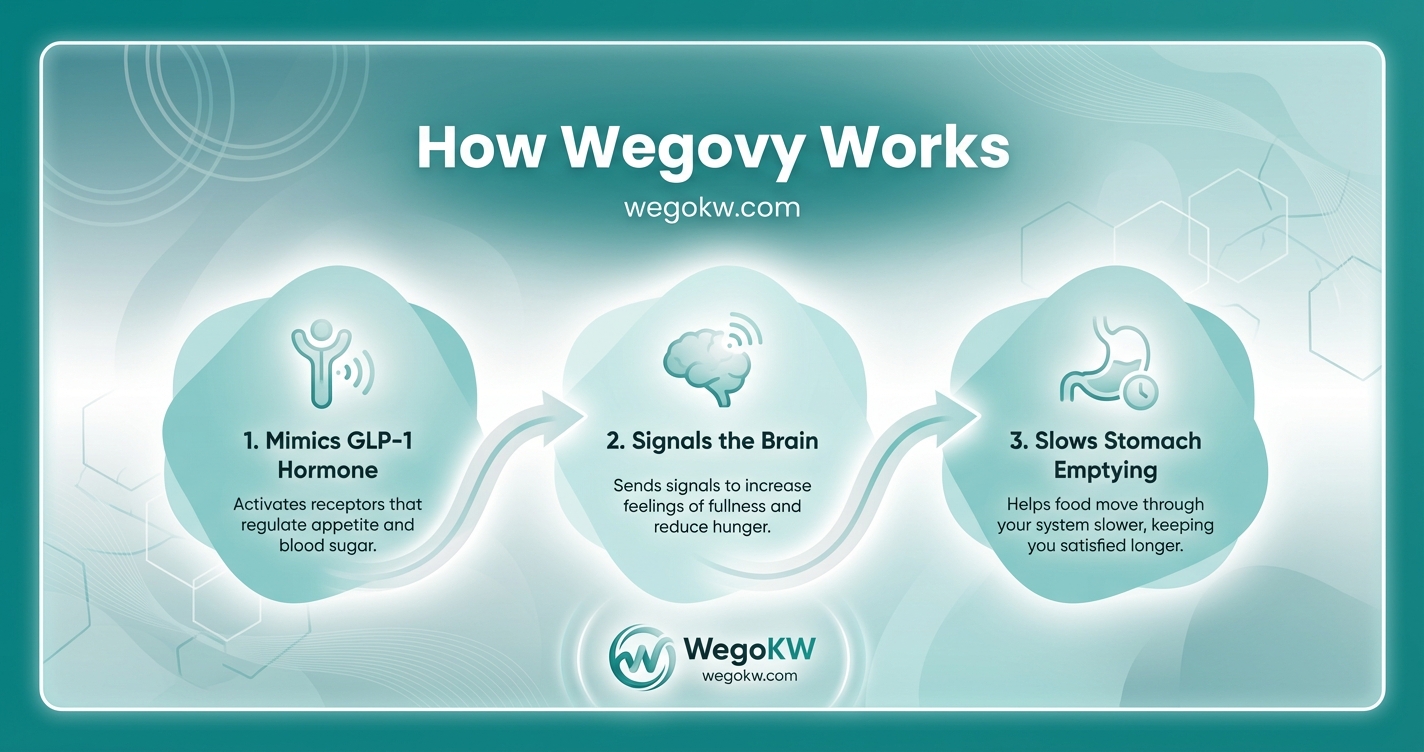
Wegovy works by copying a natural hormone that tells your brain you are full. That is the short answer. When you take your weekly injection, the medication travels to your brain to turn down your appetite, and to your stomach to slow down how fast your food digests.
If you are looking into weight loss treatments in Kuwait, you have probably heard people talking about this medication. Many patients ask their doctors كيف يعمل ويجوفي (how does Wegovy work) or want to understand the آلية عمل ويجوفي (Wegovy mechanism of action) before spending money at the pharmacy.
Understanding what this medication actually does inside your body helps you get better results. It also helps you manage the side effects. Here is exactly what happens after you take your dose.
The Science: Mimicking Your Body's Fullness Hormone
Every time you eat a meal, your intestines release a hormone called GLP-1 (glucagon-like peptide-1). This hormone acts like a messenger. It travels up to your brain and says, "We have enough food, you can stop eating now."
The problem is that natural GLP-1 only lasts in your body for a few minutes before it breaks down.
Wegovy contains an active ingredient called semaglutide. Semaglutide is a GLP-1 receptor agonist. In plain English, this means it is a synthetic copy of your natural GLP-1 hormone. But there is one major difference. Instead of breaking down in a few minutes, the semaglutide in Wegovy is modified to last for a full week [novo_wegovy_pi].
Because the medication stays in your system for seven days, your brain is constantly receiving the signal that you are full, even if you have not eaten a large meal.
The Two Main Ways Wegovy Helps You Lose Weight
Wegovy does not burn fat directly. It does not speed up your metabolism like caffeine or older weight loss pills. Instead, it changes your behavior by altering your biology. It does this in two specific areas of your body.
1. The Brain: Reducing Appetite and Food Noise Your brain has a specific area called the hypothalamus, which controls hunger and thirst. Wegovy binds to the receptors in this part of the brain.
When the medication activates these receptors, you feel physically less hungry. You will likely find yourself satisfied with much smaller portions. A meal that used to leave you wanting dessert might now make you feel completely stuffed halfway through.
But for many people, the biggest change happens with something called "food noise." Food noise is the constant mental chatter about eating. It is the voice in your head that wonders what is for lunch while you are still eating breakfast. It is the urge to check the fridge late at night, or the inability to ignore a box of sweets sitting in the office breakroom.
Wegovy quiets this mental chatter. Many patients report that they simply stop thinking about food between meals. You can read more about this specific psychological effect in our guide to Wegovy and food noise.
2. The Stomach: Slowing Down Digestion The second part of the Wegovy mechanism happens in your stomach. The medication slows down a process called gastric emptying.
Normally, when you eat, your stomach breaks down the food and pushes it into your intestines relatively quickly. Wegovy puts the brakes on this process. Food stays sitting in your stomach for a much longer time.
This delayed emptying physically keeps you full. Because your stomach is literally still processing your last meal, you have no physical room or desire for a snack a few hours later.
However, this slowed digestion is also the exact reason why the medication causes stomach issues. If you eat a heavy, greasy meal, it will sit in your stomach for hours, which can make you feel sick. About 44 out of 100 people experience nausea when taking this medication, especially in the beginning [step1_nejm]. We have a detailed breakdown of how to handle this in our Wegovy side effects article.
How the Mechanism Fits into Life in Kuwait
Living in Kuwait presents a few unique challenges when you are taking a medication that changes how your stomach works. The local climate, culture, and lifestyle require some adjustments.
Summer Heat and Hydration During the Kuwait summer, temperatures regularly pass 50°C. Staying hydrated is a daily necessity. But because Wegovy slows down your stomach, drinking a massive amount of water all at once can backfire. If you chug a large bottle of cold water after walking outside, that water will pool in your slow-moving stomach. You will likely feel bloated or nauseous. The trick is to sip water constantly throughout the day rather than drinking large amounts at once.
Ramadan Fasting The Wegovy mechanism makes Ramadan fasting complicated. The traditional way of breaking your fast—eating a large, rich iftar followed by sweets—will almost certainly make you sick on this medication. Your stomach simply cannot empty fast enough to handle a sudden, heavy influx of food after 14 hours of fasting. If you take Wegovy during Ramadan, you have to break your fast with a very small portion, wait an hour or two, and then eat a little more.
Late Dinners In Kuwait, it is very common to eat dinner late at night, often after 9:00 PM or 10:00 PM. If you eat a late dinner on Wegovy and then go to sleep, that food will sit in your stomach all night. Many patients wake up with acid reflux or morning nausea because of this. You will likely need to move your last meal to earlier in the evening.
The Financial Investment Wegovy is not cheap. At Spirit Pharmacy in Kuwait, the maintenance dose (2.4 mg) costs 94.750 KWD per month, while starting doses begin at 39.480 KWD. Understanding the mechanism helps you protect this investment. If the monthly cost feels heavy, Spirit offers interest-free installments through Tabby, Taly, and Deema, splitting your payment into 4 equal parts. If you pay for the medication but continue trying to force yourself to eat large portions, you will just feel sick and defeat the purpose of the drug. The medication gives you the biological control to eat less; you have to work with it, not against it.
The Timeline: What Happens When You Start
Wegovy is not a quick fix. The mechanism takes time to build up in your body. Doctors prescribe it in a very specific step-up schedule, called titration.
You start on a very low dose of 0.25 mg once a week. You stay on this dose for four weeks. Then you move to 0.5 mg, then 1.0 mg, then 1.7 mg, and finally the maintenance dose of 2.4 mg.
Why do we do this? Because your stomach and brain need time to adjust to the synthetic hormone. If you injected the full 2.4 mg dose on your first day, your stomach would slow down so drastically that you would likely end up in the hospital with severe vomiting.
Here is what the timeline generally looks like for most people:
Weeks 1 to 4 (0.25 mg): You might notice a slight drop in appetite, or you might feel nothing at all. Both are completely normal. The goal right now is just getting your body used to the medication. Some people lose a little weight here, mostly water weight.
Weeks 5 to 8 (0.5 mg): The delayed gastric emptying becomes more noticeable. You will likely feel full much faster during meals. This is also when side effects like mild nausea or constipation tend to show up.
Weeks 9 to 12 (1.0 mg): By the time you reach the 1.0 mg dose, the medication is actively suppressing your appetite and quieting food noise. You should be seeing steady, consistent weight loss.
Months 4 and Beyond (1.7 mg to 2.4 mg): This is where the real clinical results happen. In the STEP 1 clinical trial, which studied nearly 2,000 people, patients lost an average of 15% of their body weight over 68 weeks [step1_nejm]. At this stage, your body has adapted to the medication, side effects usually fade, and your new eating habits become your normal routine.
Who Does This Mechanism Work Best For?
Wegovy is approved for adults with a body mass index (BMI) of 30 or higher. It is also approved for adults with a BMI of 27 or higher who have a weight-related health condition, like high blood pressure or high cholesterol [kuwait_ha_leaflet].
The mechanism works incredibly well for people who struggle with portion control, constant snacking, or emotional eating. Because it physically stops you from overeating and mentally stops you from obsessing over food, it breaks the cycle that many traditional diets fail to fix.
That said, the medication does not work in a vacuum. If you eat highly processed, calorie-dense foods—like drinking milkshakes or eating pure sugar—you can still consume too many calories even if the physical volume of food is small. The mechanism forces you to eat less, but you still have to choose to eat well.
Common Questions
Does Wegovy burn fat directly? No. Wegovy does not act on your fat cells to burn them away. It reduces your appetite and slows your digestion so that you eat fewer calories. Your body then burns its stored fat for energy because you are eating less food.
Will I regain the weight if I stop taking it? Most likely, yes. Clinical studies show that when people stop taking semaglutide, their natural appetite returns and their stomach digestion speeds back up. Without the medication's mechanism in place, most people regain a significant amount of the weight they lost within a year [step1_extension]. Wegovy is designed to be a long-term treatment, much like blood pressure medication.
How is the Wegovy mechanism different from Ozempic? The mechanism is exactly the same. Both Wegovy and Ozempic contain the exact same active ingredient: semaglutide. The difference is the dosage and the official approval. Ozempic maxes out at 1.0 mg or 2.0 mg and is approved for type 2 diabetes. Wegovy goes up to 2.4 mg and is specifically approved for weight loss.
Does Wegovy work for everyone? No. While it is highly effective for most, a small percentage of people are "non-responders." Their bodies simply do not react strongly to the GLP-1 mechanism. If you have not lost at least 5% of your body weight after a few months on the higher doses, your doctor may suggest stopping the medication and trying a different approach.
Related Pages * Understanding Wegovy and Food Noise * Managing Wegovy Side Effects
*
This article is based on the Kuwait HA-approved Wegovy leaflet (revised September 2024) and published clinical evidence. It does not replace advice from your doctor.